
Sub-Total: $0.00
Protein and Fiber for Women: Why They Matter for Energy, Hormones, and Metabolism

Protein and Fiber for Women: Why They Matter for Energy, Hormones, and Metabolism
January often arrives with a long list of expectations around health.
Set resolutions.
Overhaul your eating.
Get serious about workouts, steps, and nutrition goals.
Start fresh — all at once.
Inside NOURISH, the approach is simpler.
Instead of trying to tackle everything at once, health is broken down into small, supportive starting points — shifts that fit into real life and allow the body to respond with steadiness rather than stress.
When it comes to nutrition, there is one place every NOURISH health client begins.
Protein and fiber.
Not as rules to follow or numbers to chase — but as foundational supports that help the body function well.
In this article, you’ll learn why protein and fiber matter, what they do inside the body, and how they support energy, hormones, and metabolism. You’ll also find practical examples of where they show up in real food, along with gentle, science-based guidance to help you understand what your body actually needs to function at its best.
This isn’t about overhauling your nutrition.
It’s about starting in the right place, with clarity, confidence, and care.
Why Protein and Fiber Are Foundational
When protein and fiber are present consistently throughout the day, energy tends to feel steadier and more reliable. Hunger feels calmer instead of urgent. Cravings soften rather than demand attention. Meals feel grounded rather than rushed or reactive.
This isn’t willpower. It’s biology.
Protein and fiber slow digestion and help regulate how steadily blood sugar rises and falls. When that rhythm is more stable, the brain receives clearer signals about hunger, fullness, and energy. The body doesn’t have to overcorrect or send distress signals in the form of crashes or cravings.
When your body is consistently given the macronutrients it needs — not perfectly— it responds by doing what it was designed to do.
It steadies.
It regulates.
It supports you.
What Protein Does in Your Body
Protein gives your body structure.
It’s the primary building block for muscle, and muscle plays a much bigger role in your health than most women have been taught. Muscle isn’t just about strength or appearance; it’s active tissue that helps your body use energy well.
The more supported your muscle is, the better your body can manage blood sugar, respond to insulin, and maintain steady energy throughout the day, even when you’re resting.
This is why many clinicians, including Peter Attia, emphasize protein intake for women, not for weight loss, but for metabolic health, longevity, and resilience over time.
One key insight from current health science is that when you eat, protein matters. Many women consume most of their protein at dinner, leaving the body under-supported earlier in the day.
When protein is spread more evenly across meals, your body has consistent access to the building blocks it needs. Blood sugar tends to stay steadier. Energy feels more reliable. Hunger and cravings are less likely to build momentum as the day goes on.
This is what a more consistent approach to nourishing your body can look like. Rather than compensating later with fatigue, irritability, or persistent hunger, the body feels supported throughout the day.
Protein is one of the ways you signal safety to the body, and when the body feels supported, it responds by working with you instead of against you.
Why Fiber Matters Just as Much
Fiber works alongside protein as one of the body’s key regulators.
When fiber is present in meals, it slows the rate at which food moves through the digestive system. This helps blood sugar rise and fall more gradually, which supports steadier energy and calmer hunger signals. Fiber also feeds the beneficial bacteria in your gut, which play an essential role in digestion, inflammation, and hormone balance.
One of fiber’s lesser-known roles is supporting hormone metabolism—particularly estrogen. Adequate fiber helps the body bind and eliminate excess hormones so they don’t continue circulating and contributing to symptoms over time.
Fiber also contributes to how satisfied you feel after eating. When meals contain enough fiber, fullness lasts longer, and the body is less likely to send urgent signals for quick energy in the form of sugar or refined carbohydrates.
When fiber intake is low, the body often communicates clearly. You may notice bloating, constipation, energy dips, or a stronger pull toward sweets and snacks between meals.
This isn’t a failure. It’s biology.
Your body is responding to a missing support and asking for what it needs.
Gentle Science-Based Guidance (Not Rules)
Your body functions best when it has a steady supply of protein and fiber.
Protein supports muscle, metabolism, and blood sugar regulation.
Fiber slows digestion and helps keep blood sugar and hunger signals steady.
When both are present consistently, energy is more stable, and the body doesn’t have to compensate with cravings or crashes.
Because of this, a simple, science-based starting point looks like:
Protein: about 25–35 grams at a meal
Fiber: foods that naturally add up to about 25–40 grams across the day
These aren’t numbers you need to track or hit perfectly.
They’re reference points, a way to understand what enough looks like so your body can function the way it was designed to.
The goal isn’t precision.
The goal is steady nourishment.
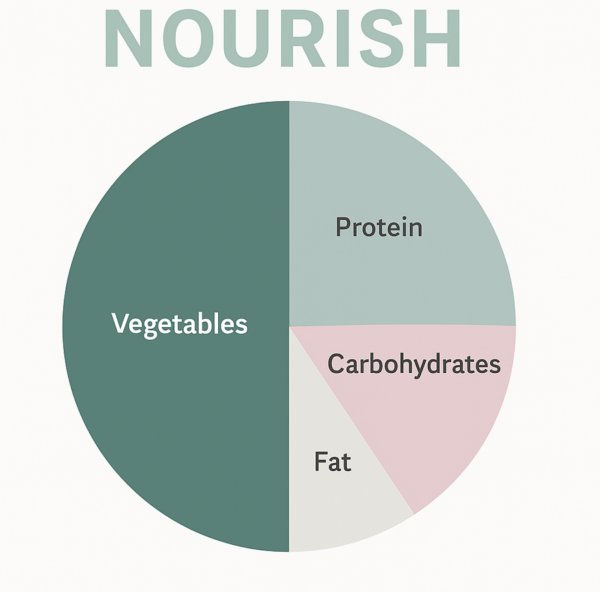
The NOURISH Plate Model
The NOURISH Plate Model is a simple visual to help you build meals that deliver what your body needs.
It’s not about precision or perfection.
It’s about structure.
When you set up your plate this way, it becomes much easier to include the nutrients that support steady energy, calmer hunger, and balanced blood sugar, without tracking or second-guessing.
Half of the plate is filled with vegetables, which provide fiber, micronutrients, and the volume that helps meals feel satisfying.
A quarter of the plate is protein, offering the structure your body relies on for muscle support, metabolism, and steady energy.
The remaining portion is shared between carbohydrates and healthy fats, which supply fuel, nourishment, and enjoyment.
When your plate is built this way, it’s hard to miss. The body receives what it needs. Meals feel more complete. Nourishment becomes simpler, not stressful.
What This Can Look Like in Real Life
Here are some ideas, a few of my favorites, showing where protein and fiber show up in everyday foods.
Protein (everyday favorites)
| Food | Serving | Protein |
|---|---|---|
| Eggs | 2 large | 12 g |
| Greek yogurt | 1 cup | 18–20 g |
| Cottage cheese | 1 cup | 24 g |
| Chicken breast | 4 oz | 26 g |
| Salmon | 4 oz | 22 g |
| Ground turkey | 4 oz | 22 g |
| Lentils | 1 cup cooked | 18 g |
| Tofu | ½ block | 20 g |
| Protein powder | 1 scoop | 20–25 g |
| Grass-fed beef | 4 oz | 24 g |
Fiber (plant-forward staples)
| Food | Serving | Fiber |
|---|---|---|
| Broccoli | 1 cup cooked | 5 g |
| Brussels sprouts | 1 cup cooked | 6 g |
| Raspberries | 1 cup | 8 g |
| Lentils | ½ cup cooked | 8 g |
| Black beans | ½ cup | 7 g |
| Chia seeds | 2 Tbsp | 10 g |
| Ground flax | 1 Tbsp | 3 g |
| Avocado | ½ medium | 5 g |
| Oats | ½ cup dry | 4 g |
| Sweet potato | 1 medium | 4 g |
A Gentle Place to Begin
You don’t need to track every gram.
You don’t need to aim for perfect numbers.
You don’t need to overhaul everything at once.
A good place to begin is simply noticing.
Notice what you eat most days.
Notice where protein and fiber show up on your plate.
This isn’t about jumping from where you are to where you think you should be.
It’s about understanding your current foundation so you can build from there.
If your protein or fiber intake is low right now, that’s okay. Don’t leap from 10 to 40 overnight. The body responds better to steady support than sudden extremes.
Add a little.
Let your body respond.
Then build from there.
Your body is wise.
It will guide you when you begin to listen.
A simple question to return to is this:
What does my body need more of right now to feel supported?
That might look like adding protein to breakfast.
It might mean letting vegetables take up more space at lunch.
It might be building dinner with protein and plants first, then adding carbohydrates and fats.
One meal.
One choice.
One small shift.
That’s how nourishment becomes sustainable.
Nourishment Is an Act of Stewardship
When I talk about nourishment, I’m not talking about control or perfection.
I’m talking about stewardship.
Stewardship is simply caring well for what has been entrusted to you. In this case, your body.
It isn’t about doing everything “right.”
It’s about paying attention.
Responding with care.
And making choices that support how your body is designed to function.
Choosing protein and fiber more consistently isn’t about rules or restriction. It’s a steady way of honoring your body’s needs by listening and responding without extremes.
Stewardship starts exactly where you are, not where you think you should be.
As your body receives more consistent support, energy steadies. Hunger cues become clearer. Cravings soften.
That’s stewardship in practice.
It’s quiet.
It’s steady.
It’s faithful care, practiced one meal at a time.
When nourishment is approached this way, your body doesn’t have to fight for attention. It begins to guide you toward what it needs next.
As protein and fiber become more consistent, the rest of the plate begins to make more sense.
In the next article, we’ll take a closer look at carbohydrates and fats, how they support energy, hormones, and satisfaction, and how to include them in a way that works with the foundation you’re building here.
About The Author: Ann Hackman is a Certified Health Coach (IIN) and NASM Personal Trainer with advanced training in hormone health and metabolism. She’s the creator of NOURISH, a faith-based, science-backed health coaching program that helps women restore energy, balance hormones, and feel at home in their bodies again.