
Sub-Total: $0.00
Creatine for Women Over 40: What the Science Says About Brain Fog, Muscle Loss, and Menopause
Creatine for Women Over 40: What the Science Says About Brain Fog, Muscle Loss, and Menopause
Pour yourself a cup of coffee — I want to talk about something that has been on my heart.
If you are in your 40s or 50s, there is a good chance that your health has shifted. Maybe you are doing everything you used to do, and your body just is not responding the same way. The energy feels different. Your thinking is fuzzier than it used to be. You look in the mirror and wonder where on God’s amazing green earth your muscle went.
Here is what I want you to hear before we go any further: this is not you failing. This is your body moving through a season of change that God designed. The question is never what is wrong with me. The question is, how do I nourish myself well right here, right now?
That shift, from striving to nourishing, changes everything.
And today that conversation is about creatine for women over 40 — what it is, what the science actually shows, and whether it deserves a place in your daily routine.
So when something like creatine starts showing up everywhere, my job is to cut through the noise and give you what you actually need to make a wise, informed decision for your own body. That is what we are doing today.
I am a certified health coach, not a physician. Always bring your doctor into the conversation before starting any new supplement.
AT A GLANCE
What it does: Helps your cells make energy faster
Who it is for: Women navigating brain fog, muscle loss, or hormonal changes
How to take it: 3 to 5 grams of creatine monohydrate daily
Is it safe: Yes, for healthy women — talk to your doctor first.
So What Even Is Creatine?
Your body already makes creatine. It is not some foreign substance invented in a lab. It is a compound that your liver and kidneys produce naturally, and you also get small amounts from foods like red meat and fish. Its job is to help your cells make energy.
Here is the simple version of how it works.
Your body runs on a fuel called ATP — think of it as your cellular battery. Every time your muscles move, every time your brain fires, ATP gets used up. When it runs low, your body has to pause and recharge before it can keep going.
Creatine helps speed up that recharge. It helps your cells produce fresh energy faster, which means your muscles can do more, your brain can think more clearly, and your body can recover more efficiently.
Here is something that stood out to me when I first read the research. Most women have 70 to 80 percent lower creatine stores than men. We tend to eat less red meat, we have less muscle mass, and our bodies store less of it naturally. According to a 2021 review published in the journal Nutrients, this gap suggests that women may have more to gain from supplementation than men do. (Read the study)
Here Is What Caught My Attention in the research.
Brain fog is real. And creatine may actually help.
Brain fog is one of the most common things I hear from women navigating this season. The lost words, the fuzzy thinking, the feeling that you just cannot get sharp. And while hormones are a big piece of that story, there is another piece worth knowing about.
Your brain is one of the most energy-hungry organs in your body. Creatine plays the same role in brain cells as it does in muscle cells — it helps maintain a steady energy supply. When that supply dips, cognitive function often follows.
A 2022 meta-analysis published in Nutrition Reviews found that creatine supplementation showed meaningful benefits for memory performance, particularly in adults over 66. (Read the study)
A broader 2024 systematic review covering 16 randomized controlled trials found that women specifically showed notable improvements in memory, attention, and processing speed with creatine supplementation. (Read the study)
The research is still growing, and more large-scale trials are needed, but the direction is consistently encouraging. And importantly, these cognitive benefits show up whether or not you exercise. You do not have to be in the gym to benefit here.
If brain fog has been stealing your clarity, this is worth a conversation with your doctor.
Losing muscle after 40 is normal. Accepting it is optional.
After 40, we naturally begin losing muscle mass. That process accelerates through menopause if we are not working to counter it. I share this not to alarm you but to empower you, because this is one of the most actionable things we can address together.
Muscle is tied to your metabolism, bone density, balance, energy, and long-term independence. There is genuinely no stage of life where losing muscle serves you well.
Creatine, especially when paired with strength training, has been consistently shown to help preserve and build lean muscle in women. A meta-analysis published in the Open Access Journal of Sports Medicine found that creatine supplementation during resistance training significantly increased lean tissue mass and upper- and lower-body strength in older adults. (Read the study)
I have been strength training for years, and creatine has been part of my daily routine throughout. The muscle benefit is strongest when paired with resistance training, but the brain and hormonal benefits stand entirely on their own. Wherever you are on your movement journey, this conversation is for you.
If preserving your strength and metabolism as you age matters to you, creatine is worth exploring.
Your hormones and your creatine are more connected than you know.
This one is fascinating, and I think it will surprise you.
Estrogen actually influences how your body produces and uses creatine. As estrogen declines through perimenopause and menopause, your creatine metabolism shifts with it. It is one more reason this season can feel so different from every season before it, and one more reason that what worked before may not feel like enough anymore.
A 2021 review in Nutrients laid this out clearly, noting that hormonal changes throughout a woman’s life alter creatine synthesis, transport, and availability, making supplementation particularly relevant during and after menopause. (Read the study)
A 2025 randomized controlled trial specifically examining perimenopausal and postmenopausal women found that 8 weeks of creatine supplementation improved reaction time and showed promising trends for mood support. It is worth noting that the study was small, and researchers found no significant effect on some other menopausal symptoms, so more research is needed. But the direction is encouraging, and the biology behind it makes sense. (Read the study)
There is also emerging research connecting creatine to mood support in women through its role in brain energy and neurotransmitter function. This is early science, but it is worth watching closely.
If you are in perimenopause or postmenopause and feeling the effects of hormonal change in your energy and mood, creatine may be a simple and meaningful addition to your routine.
Is It Safe?
Creatine is one of the most researched supplements available, and the evidence consistently supports its safety for healthy women. A few things worth knowing:
Kidney health. If you have any existing kidney concerns, talk to your doctor before starting.
Lab work. Creatine can slightly elevate a marker called serum creatinine in your bloodwork. This is not a sign that anything is wrong, but it is worth pausing creatine one to two weeks before labs and letting your doctor know you take it.
Pregnancy. The guidance is to avoid supplementing during pregnancy unless your OB specifically recommends it, as research in this area is still limited.
How to Take It
Simple is always the path here.
3 to 5 grams of creatine monohydrate daily is what the research supports. No loading phase needed. Take it any time of day, with or without food. I stir mine into my morning water and move on with my day.
Creatine monohydrate is the gold standard — the most studied, most effective, and most affordable form available. Fancy advanced versions offer no additional benefit over the simple stuff.
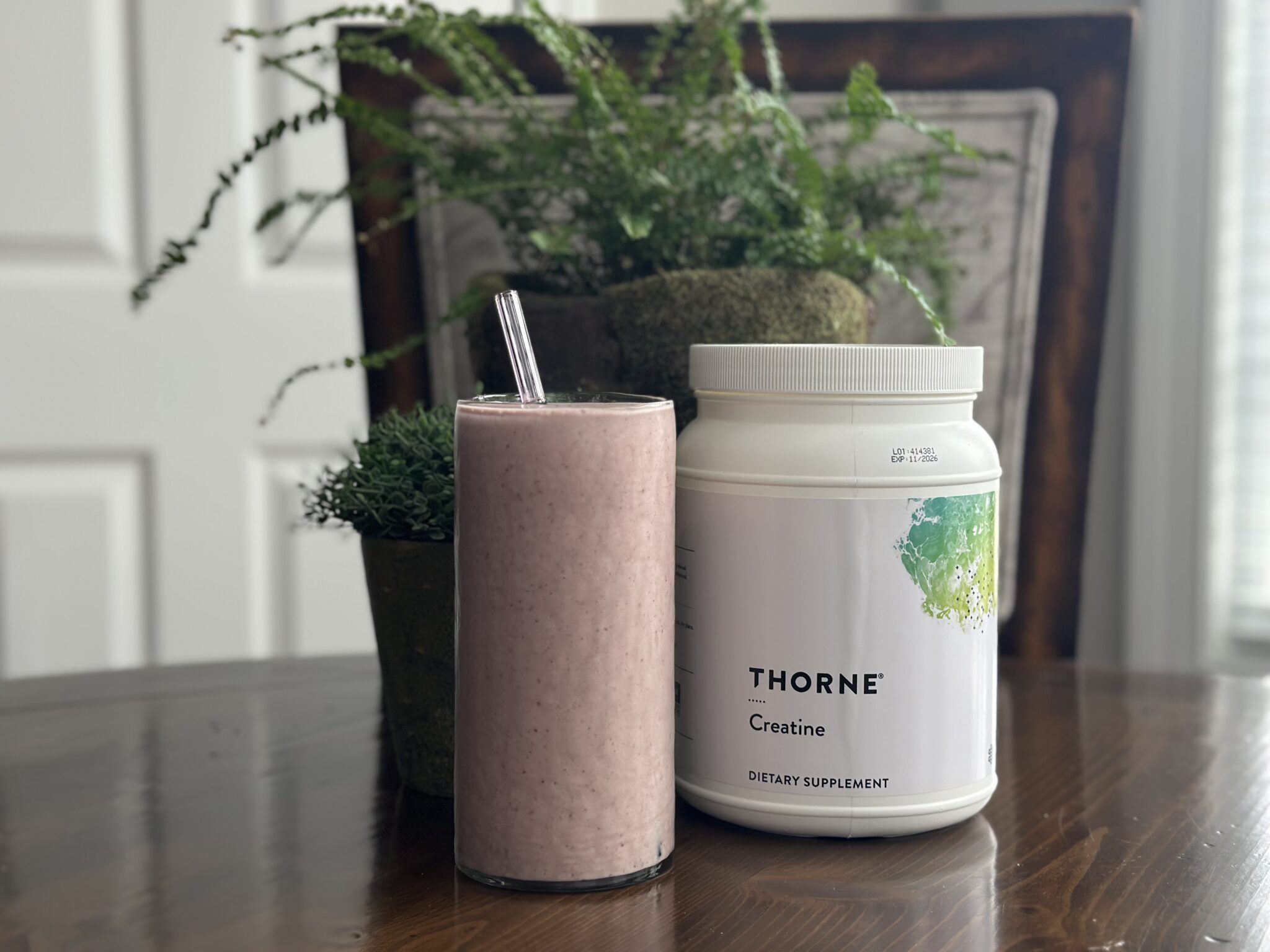
The creatine I personally use and trust is Thorne Creatine Monohydrate. I recommend the unflavored powder—it stirs easily into water, a smoothie, or an electrolyte drink —and you will not taste a thing. Thorne is a brand I recommend across the board for its rigorous quality testing and clean ingredients.
My gift to you as my reader is 25% off storewide when you order through my dispensary.
[Order Thorne Creatine Monohydrate here]
A Gentle Invitation
As you move through this season, stay curious.
Notice your energy. Notice your mental clarity. Notice how your body feels as you make small, intentional choices to nourish it well.
You do not need to do everything at once. One conversation with your doctor, one simple daily habit, one step forward is still forward. And if this season feels more complicated than you expected, you are not behind. You are learning.
That is the heart of NOURISH.
Nourishing yourself well here is not settling. It is wisdom.
If this kind of teaching resonates with you — real science, practical tools, and faith woven together — the NOURISH Community is where we go deeper every single month. It is a private, faith-centered space for women navigating midlife health together, with guidance, encouragement, and steady support.
About the Author: Ann Hackman is a Certified Health Coach (IIN) and NASM Personal Trainer with advanced training in hormone health and metabolism. She’s the creator of NOURISH, a faith-based, science-backed health coaching program that helps women restore energy, balance hormones, and feel at home in their bodies again.